دوریس لسینگ رمان نویس برنده جایزه ادبی نوبل درگذشت

دوریس لسینگ رمان نویس برنده جایزه ادبی نوبل درگذشت


دوریس لسینگ بانوی 94 ساله بریتانیایی که متولد ایران بود و در سال 2007 موفق به کسب جایزه ادبی نوبل شده بود، صبح امروز بدرود حیات گفت. 

به گزارش خبرگزاری مهر به نقل از اینترنشنال، دوریس لسینگ خالق «دفترچه طلایی» در خانه اش در لندن درگذشت .

وی که سال 1919 در ایران به دنیا آمده بود، از پنج سالگی به جنوب رودزیا رفت و بعد راهی لندن شد و در جریان جنگ جهانی دوم نوشتن اولین رمانش با عنوان «علف ترانه می خواند» را به پایان رساند.  

این رمان سال 1950 منتشر شد و یکی از 54 اثری بود که او در طول عمرش خلق کرد.

وی در سال 2007 و در 88 سالگی نام خود را به عنوان سالخورده ترین نویسنده برنده جایزه ادبی نوبل ثبت کرد و یازدهمین نویسنده زنی بود که این جایزه را دریافت کرد.

جاناتان کلوز از دوستان نزدیک و کارگزار ادبی وی با اعلام خبر درگذشت وی گفت از خانم لسینگ دختری به نام جین و نوه هایش آنا و سوزانا باقی مانده اند و خانواده کوچک او خواستار حفظ حریم شخصی شان در این لحظات هستند. 

آخرین گفتگوی مهر با فهیمه رحیمی

آخرین گفتگوی مهر با فهیمه رحیمی؛
 
 
«من هم این شایعه‌ها را شنیده‌ام که فهیمه رحیمی ثروتمندترین نویسنده زن ایرانی است؛ آواز دهل شنیدن از دور خوش است».
 

شنیده‌ام می‌گویند من ثروتمندترین نویسنده زن ایرانی هستم


خبرگزاری مهر - گروه فرهنگ و ادب: فهمیه رحیمی را به جرات می‌توان «دانیل استیل» ایران خواند. او به فاصله کمی بعد از نگارش نخستین کتابش «بازگشت به خوشبختی» به رمان‌نویسی مشهور تبدیل شد و کمتر کسی بود در ایران که با کتاب سر و کار داشته باشد و نام او را نشنیده باشد. رحیمی مدت‌ها رکورددار فروش آثار ادبی در ایران بود و بسیاری او را ثروتمندترین نویسنده زن ایرانی می‌دانستند اما جالب است بدانید فهیمه رحیمی نه تحت پوشش بیمه بود و نه حتی یک خودروی شخصی داشت اما چندان به این مسائل هم اهمیت نمی‌داد و می‌گفت «هر وقت پرنده کلمه دور سرم پرواز کند، می‌دانم باید دست به قلم بنشینم و وارد دنیای تازه‌ای شوم».

فهمیه رحیمی در خرداد 1331 در خیابان شهباز تهران متولد شد. در37 سالگی (1368) نخستین رمان خود را منتشر کرد؛ «بازگشت به خوشبختی». اتوبوس، عشق و خرافات، کوچه باغ یادها، برجی در مه، خلوت شب‌های تنهایی، روزهای سرد برفی، خیال تو، عالیه، رز کبود، شیدایی، بانوی جنگل، حرم دل، آریانا، پنجره، بازگشت به خوشبختی، تاوان عشق، پاییز را فراموش کن، ماندانا، زخم‌خوردگان تقدیر، هنگامه، ابلیس کوچک، اشک ستاره و... از دیگر آثار اوست. بسیاری از این کتاب‌ها بیش از 10 بار تجدید چاپ شدند.

فهیمه رحیمی با داشتن 7 کتاب در میان 47 کتاب پرفروش پس از انقلاب، رکورددار فروش کتاب در ایران بوده است. این نویسنده معروف ایرانی ساعت 5 صبح امروز 28 خرداد و در پی ابتلا به سرطان معده در بیمارستان مهر تهران درگذشت. او در یکی از آخرین مصاحبه‌هایش که سال 88 با خبرگزاری مهر انجام داد، درباره شایعاتی که پیرامون ثروت او وجود دارد، تنها گفت: آواز دهل شنیدن از دور خوش است. این مصاحبه در ذیل از نظرتان می‌گذرد:

خبرگزاری مهر - گروه فرهنگ و ادب: شاید خیلی از کسانی که شما را از دور به عنوان نویسنده‌ای با بیش از 30 عنوان کتاب پرفروش - که بارها و بارها تجدید چاپ شده‌اند - می‌شناسند، فکر کنند نویسندگی شغل و حرفه درآمدزای شما است. آیا واقعا اینگونه بوده است؟

- فهیمه رحیمی: شما که می‌دانید از آن کتابهای پرفروش جز مبلغ قراردادم با ناشر چیزی به من نمی‌رسد. آواز دهل شنیدن از دور خوش است، من هم این شایعه‌ها را شنیده‌ام که فهیمه رحیمی ثروتمندترین نویسنده زن ایرانی است ولی واقعیت را همه مردم نمی‌دانند. من حتی یک وسیله نقلیه شخصی هم ندارم.

ادامه نوشته

«فهیمه رحیمی» درگذشت

«فهیمه رحیمی»

نویسنده‌ی داستان‌های عامه‌پسند

صبح امروز - سه‌شنبه 28 خرداد - درگذشت

شنیده‌ام می‌گویند من ثروتمندترین نویسنده زن ایرانی هستم


بابک شیرازی، فرزند این داستان‌نویس سرشناس با اعلام این خبر به خبرنگار کتاب خبرگزاری دانشجویان ایران (ایسنا) گفت: مادرم صبح امروز - 28 خرداد ساعت 5 بامداد - پس از یک دوره‌ بیماری در سن 61 سالگی از دنیا رفت.

او افزود: بیماری مادرم سرطان معده بود که از سه سال پیش آغاز شده بود که بعد از یک عمل جراحی مدتی خوب شده بود، اما پس از مدتی، بیماری او دوباره برگشت و دیگر درمان پاسخگو نبود تا اینکه از 15 روز پیش بیماری او شدت گرفت و از سه چهار روز پیش در بخش آی.سی.یو در بیمارستان مهر بستری شد و متاسفانه صبح امروز ساعت 5 صبح درگذشت.

شیرازی در ادامه درباره‌ی مراسم تشییع و تدفین این داستان‌نویس اظهار کرد: در حال حاضر پیگیر هستیم تا از وزارت ارشاد مجوز خاکسپاری ایشان را در قطعه هنرمندان بگیریم و تمام سعی‌مان این است که مراسم تشییع همین امروز برگزار شود.

فهیمه رحیمی متولد 1331 در تهران بود. «ابلیس کوچک»، «اتوبوس»، «آریانا»، «اشک و ستاره»، «باران»، «بازگشت به خوشبختی»، «بانوی جنگل»، «پاییز را فراموش کن»، «پریا»، «پنجره»، «تاوان عشق»، «حرم دل»، «خلوت شب‌های تنهایی»، خیال تو»، «روزهای سرد برفی»، «زخم خوردگان تقدیر»، «سال‌هایی که بی تو گذشت»، «شیدایی»، «عشق و خرافات»، «کوچه باغ یادها»، «ماندانا»، «هنگامه» از جمله کتاب‌های این نویسنده هستند.

The Metamorphosis Franz Kafka

"The Metamorphosis"

Franz Kafka

INTRODUCTION

The Metamorphosis is one of the most frequently analyzed works in literature. This elusive story, which chronicles the transformation of Gregor Samsa from a human being into an enormous insect, is renowned for its ability to inspire diverse, sometimes mutually exclusive interpretations. For this reason The Metamorphosis has come to be considered one of the central enigmas of the modern literary imagination. Nevertheless, critics generally praise Kafka's powerful and symbolic portrayal of alienation achieved through the literalized metaphor of man as insect.

Plot and Major Characters

The Metamorphosis opens as Gregor Samsa, a traveling salesman, awakes to find himself transformed into a "monstrous vermin." Initially shocked by the change, Gregor soon begins to worry that he will miss his train and be late for work. He also laments the boredom of his job, employment to which he had resigned himself for as long as necessary to pay off his parents' debts. From outside the room, Gregor's worried mother calls to him. Gregor, unfamiliar with his new body, struggles to get out of bed. Later, the chief clerk of his office appears outside the locked door to Gregor's room, inquiring why his employee has missed the early train. Speaking through the door, Gregor claims that he is slightly ill but will soon be on his way. Meanwhile, Gregor's concerned mother asks her daughter Grete to call for a doctor and a locksmith. Finally Gregor manages to open his door. His appearance startles the chief clerk, and although Gregor tries to reason with him, claiming he will get dressed and be on his way to work, the clerk retreats from the giant insect, as does Gregor's frightened mother. Gregor's father then appears and drives Gregor back into his room.

Time passes, and Gregor's family members grow more accustomed to living with Gregor in this strange form, though only Grete has the courage to enter her brother's room in the ensuing days. When Gregor leaves his room weeks later, his mother becomes distraught, and her husband forces Gregor to his room under a hail of thrown apples. Gravely injured and largely unable to move, Gregor suffers a lonely convalescence that lasts for more than a month. In the interim Gregor's mother devotes herself to sewing while his sister takes a job as a salesgirl. Increasingly, Gregor is neglected by his family. They hire a charwoman to attend to the heavier work around the house, tasks that used to be performed by Gregor. Odds and ends are placed in his room for storage, primarily to make space for three male lodgers the Samsas have taken in to supplement their income. One evening as Grete plays the violin for these men, Gregor is attracted by the music and crawls unnoticed into the living room. Later, one of the boarders observes him. Citing the revolting condition of the household, the lodgers threaten to give notice and depart. Grete realizes that they must get rid of this giant bug, which she seems to no longer view as her brother. The following morning, the charwoman enters Gregor's room and finds him dead. When the lodgers appear and demand breakfast, Mr. Samsa orders them to leave. Meanwhile, the giggling charwoman returns and explains that she has disposed of Gregor's body. The story closes as Gregor's parents, newly optimistic for the future and without a thought of their deceased son, comment on their daughter's vivacity and beauty, realizing she has grown into a woman.

Major Themes

Thematic analysis of The Metamorphosis has tended to focus on the psychoanalytic and symbolic, or allegorical, nature of the story. While evaluations of the narrative vary, many commentators view the theme of alienation from humanity at the center of the story and interpret Gregor's transformation as a kind of wish-fulfillment or as an extended metaphor. Critics who perceive the metamorphosis as a form of wish-fulfillment on Gregor's part find in the text clues indicating that he deeply resented having to support his family. Desiring to be in turn nurtured by them, he becomes a parasite in entomological fact. The complete dependence of Gregor's family and employer on him, then, is seen as an ironic foil to the reality of Gregor's anatomical transformation into a parasite. Many critics who approach the story in this way believe the primary emphasis of The Metamorphosis is not upon Gregor, but on his family, as they abandon their dependence on him and learn to be self-sufficient. One interpretation of the story holds that the title applies equally to Gregor's sister Grete: she passes from girlhood to young womanhood during the course of the narrative. Another view of Gregor's transformation is that it is an extended metaphor, carried from abstract concept to concrete reality: trapped in a meaningless job and isolated from the human beings around him, Gregor is thought of as an insect by himself and by others, so he becomes one.

Critical Reception

Kafka's letters to his fiancée Felice Bauer, and his diary entries concerning The Metamorphosis, indicate that although he was generally satisfied with the tale, he felt the ending was seriously flawed. For this he blamed a business trip that had interrupted him just before he completed the story. However, critics have noted that The Metamorphosis is one of the few works for which Kafka actively sought publication. Since Kafka's death, critical interest in the novella has been considerable. In addition to the attention critics have placed on thematic analysis of The Metamorphosis, several have observed its sustained realism, which contrasts with the initially fantastic occurrence of Gregor's transformation into an insect. Many critics have also offered psychoanalytical interpretations of The Metamorphosis, seeing in the work a dramatization of particularly modern neuroses. For its technical excellence, as well as for the nightmarish and fascinating nature of the metamorphosis itself, Kafka's story has elicited a vast amount of interest, and its various problematic features continue to challenge its readers. Stanley Corngold has noted that "no single reading of Kafka escapes blindness," but that each new reading of his work encourages the study of the vast body of criticism devoted to it.

Globalization and translation

Globalization and translation

Globalization has affected the translation industry just like every other industry both positively and negatively. While in the product space we have benefited from lower costs with same or superior quality manufactured from countries China, a similar trend has been found in the translation industry too. Translators from the developed world have to compete with those from the low cost countries now, but it has not pervaded much either due to language barriers. For example it is not easy to find persons fluent in languages like Swedish and also say French from countries like Sri Lanka or Bangladesh.

Globalization has resulted in increased interactions between peoples and cultures of the world. These cross cultural interactions has increased the need for translators and interpreters, thus auguring well for the translation industry as a whole. This is the positive side of globalization as far translators are concerned.

The increase in cross cultural interactions due to globalization has had an impact on changes in vocabulary too of the concerned languages. It has led to for example of increased ‘borrowing of words’ viz. adopting a word in target language as it is or in a slightly localized version of the word in the source language. This process is sometimes loosely referred to ‘foreignising’ a language and has been going on since ages and probably made life little easier for translators!

Though globalization is generally understood in the business context, there are different dimensions to globalization as it relates to the translation industry. The spread of the English language is closely associated with globalization even though other languages have benefited as well. Literature in not so well known languages has found a wider audience due to globalization. The advent of internet has added further impetus to this process. But a lot more remains to be done and it offers enormous opportunity for the translation community. There is plenty to explore and share between writers and readers from different parts of the world. Translators play a huge role in this development.

In the last decade or so since the emergence of internet and dismantling of trade barriers across borders small enterprises are pressurized to become global. This has increased the need for advertising in many different languages and the advertising industry is utilizing the services of specialized translators. Many global companies are forced to seek the help of translation agencies and translation is becoming crucial to the core business of such companies. As globalization is increasing, requirement of translation services is growing proportionately. It is expected that globalization is going to affect the translation industry in a more profound manner compared to other industries.

All in all globalization is here to stay whether one likes it or not and is a welcome development for the translating community.

What is Transcendentalism?

What is Transcendentalism?


When I first learned about Transcendentalism, Ralph Waldo Emerson and Henry David Thoreau in high school English class, I admit: I couldn't figure out what the term "Transcendentalism" meant. I couldn't figure out what the central idea was that held all those authors and poets and philosophers together so that they deserved this categorical name, Transcendentalists. And so, if you're at this page because you're having difficulty: you're not alone. Here's what I've learned since high school about this subject.

The Transcendentalists can be understood in one sense by their context -- by what they were rebelling against, what they saw as the current situation and therefore as what they were trying to be different from.

Theodore
Parker*
Theodore Parker

One way to look at the Transcendentalists is to see them as a generation of well educated people who lived in the decades before the American Civil War and the national division that it both reflected and helped to create. These people, mostly New Englanders, mostly around Boston, were attempting to create a uniquely American body of literature. It was already decades since the Americans had won independence from England. Now, these people believed, it was time for literary independence. And so they deliberately went about creating literature, essays, novels, philosophy, poetry, and other writing that were clearly different from anything from England, France, Germany, or any other European nation.

Harriet
Martineau*
Harriet Martineau

Another way to look at the Transcendentalists is to see them as a generation of people struggling to define spirituality and religion (our words, not necessarily theirs) in a way that took into account the new understandings their age made available.

The new Biblical Criticism in Germany and elsewhere had been looking at the Christian and Jewish scriptures through the eyes of literary analysis and had raised questions for some about the old assumptions of religion.

James
Martineau*
James Martineau

The Enlightenment had come to new rational conclusions about the natural world, mostly based on experimentation and logical thinking. The pendulum was swinging, and a more Romantic way of thinking -- less rational, more intuitive, more in touch with the senses -- was coming into vogue. Those new rational conclusions had raised important questions, but were no longer enough.

German philosopher Kant raised both questions and insights into the religious and philosophical thinking about reason and religion.

This new generation looked at the previous generation's rebellions of the early 19th century Unitarians and Universalists against traditional Trinitarianism and against Calvinist predestinationarianism. This new generation decided that the revolutions had not gone far enough, and had stayed too much in the rational mode. "Corpse-cold" Emerson called the previous generation of rational religion.

Thomas
Wentworth
Higginson*
Thomas Wentworth Higginson

The spiritual hunger of the age that also gave rise to a new evangelical Christianity gave rise, in the educated centers in New England and around Boston, to an intuitive, experiential, passionate, more-than-just-rational perspective. God gave humankind the gift of intuition, the gift of insight, the gift of inspiration. Why waste such a gift?

Added to all this, the scriptures of non-Western cultures were discovered in the West, translated, and published so that they were more widely available. The Harvard-educated Emerson and others began to read Hindu and Buddhist scriptures, and examine their own religious assumptions against these scriptures. In their perspective, a loving God would not have led so much of humanity astray; there must be truth in these scriptures, too. Truth, if it agreed with an individual's intuition of truth, must be indeed truth.

Ralph Waldo Emerson
Ralph Waldo
Emerson*

And so Transcendentalism was born. In the words of Ralph Waldo Emerson, "We will walk on our own feet; we will work with our own hands; we will speak our own minds...A nation of men will for the first time exist, because each believes himself inspired by the Divine Soul which also inspires all men."

Yes, men, but women too.

Most of the Transcendentalists became involved as well in social reform movements, especially anti-slavery and women's rights. (Abolitionism was the word used for the more radical branch of anti-slavery reformism; feminism was a word that was invented deliberately in France some decades later and was not, to my knowledge, found in the time of the Transcendentalists.) Why social reform, and why these issues in particular?

The Transcendentalists, despite some remaining Euro-chauvinism in thinking that people with British and German backgrounds were more suited for freedom than others (see some of Theodore Parker's writings, for instance, for this sentiment), also believed that at the level of the human soul, all people had access to divine inspiration and sought and loved freedom and knowledge and truth.

Emily
Dickinson*
Emily Dickinson

Thus, those institutions of society which fostered vast differences in the ability to be educated, to be self-directed, were institutions to be reformed. Women and African-descended slaves were human beings who deserved more ability to become educated, to fulfill their human potential (in a twentieth-century phrase), to be fully human.

Men like Theodore Parker and Thomas Wentworth Higginson who identified themselves as Transcendentalists, also worked for freedom of the slaves and for women's freedom.

Henry David Thoreau

Henry David Thoreau

(1817–1862 )

Henry David Thoreau

Henry David Thoreau (baptized David Henry Thoreau) was born on July 12, 1817 in Concord, Massachusetts, to John Thoreau and Cynthia Dunbar. He was the third of four children. He was named after a recently deceased paternal uncle, David Thoreau, but since everyone always called him Henry, he eventually changed his name to Henry David, although he never petitioned to make a legal name change. Henry's father was a businessman and active in the Concord Fire Society. His mother spent her time raising Henry and his three siblings, Helen, John and Sophia. 

When Thoreau was sixteen, he entered Harvard College, where he was known as a serious though unconventional scholar. Henry's older siblings, Helen and John, Jr., were both schoolteachers. When it was decided that their brother should go to Harvard, as had his grandfather before him, they contributed from their teaching salaries to help pay his expenses. While at college, Thoreau studied Latin and Greek grammar and composition, and took classes in a wide variety of subjects, including mathematics, English, history, philosophy, and four different modern languages. During his Harvard years he was exposed to the writings of Ralph Waldo Emerson, who later became his chief mentor and friend.

ادامه نوشته

E. E. Cummings

                                                 E. E. Cummingsوووو


Edward Estlin Cummings was born October 14, 1894 in the town of Cambridge Massachusetts. His father, and most constant source of awe, Edward Cummings, was a professor of Sociology and Political Science at Harvard University. In 1900, Edward left Harvard to become the ordained minister of the South Congregational Church, in Boston. As a child, E.E. attended Cambridge public schools and lived during the summer with his family in their summer home in Silver Lake, New Hampshire. (Kennedy 8-9) E.E. loved his childhood in Cambridge so much that he was inspired to write disputably his most famous poem, "In Just-" (Lane pp. 26-27)

Not so much in, "In Just-" but Cummings took his father's pastoral background and used it to preach in many of his other poems. In "you shall above all things be glad and young," Cummings preaches to the reader in verse telling them to love with naivete and innocence, rather than listen to the world and depend on their mind.

Attending Harvard, Cummings studied Greek and other languages (p. 62). In college, Cummings was introduced to the writing and artistry of Ezra Pound, who was a large influence on E.E. and many other artists in his time (pp. 105-107). After graduation, Cummings volunteered for the Norton-Haries Ambulance Corps. En-route to France, Cummings met another recruit, William Slater Brown. The two became close friends, and as Brown was arrested for writing incriminating letters home, Cummings refused to separate from his friend and the two were sent to the La Ferte Mace concentration camp. The two friends were finally freed, only due to the persuasion of Cummings' father. 


ادامه نوشته

کلاس زبان

 دوره هاي خصوصي و نيمه خصوصي


-    دوره هاي آمادگي IELTS   و TOEFL

-    كارگاه پيشرفته نگارش پاراگراف و مقاله انگليسي

-    دوره هاي گرامر و ساختار جمله انگليسي ( مبتدي تا پيشرفته )

-    كارگاه مهارت شنيداري (LISTENING)

-    دوره هاي مكالمه ( مبتدي تا پيشرفته )


تماس از طريق همين وبلاگ يا آدرس ايميل زير:

mashhadazadun@yahoo.com

Pablo Neruda

Pablo Neruda

 
Pablo Neruda

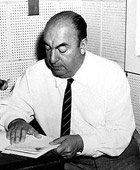
Pablo Neruda (1904-1973), whose real name is Neftalí Ricardo Reyes Basoalto, was born on 12 July, 1904, in the town of Parral in Chile. His father was a railway employee and his mother, who died shortly after his birth, a teacher. Some years later his father, who had then moved to the town of Temuco, remarried doña Trinidad Candia Malverde. The poet spent his childhood and youth in Temuco, where he also got to know Gabriela Mistral, head of the girls' secondary school, who took a liking to him. At the early age of thirteen he began to contribute some articles to the daily "La Mañana", among them, Entusiasmo y Perseverancia - his first publication - and his first poem. In 1920, he became a contributor to the literary journal "Selva Austral" under the pen name of Pablo Neruda, which he adopted in memory of the Czechoslovak poet Jan Neruda (1834-1891). Some of the poems Neruda wrote at that time are to be found in his first published book: Crepusculario (1923). The following year saw the publication of Veinte poemas de amor y una cancion desesperada, one of his best-known and most translated works. Alongside his literary activities, Neruda studied French and pedagogy at the University of Chile in Santiago.

Between 1927 and 1935, the government put him in charge of a number of honorary consulships, which took him to Burma, Ceylon, Java, Singapore, Buenos Aires, Barcelona, and Madrid. His poetic production during that difficult period included, among other works, the collection of esoteric surrealistic poems, Residencia en la tierra (1933), which marked his literary breakthrough.

The Spanish Civil War and the murder of García Lorca, whom Neruda knew, affected him strongly and made him join the Republican movement, first in Spain, and later in France, where he started working on his collection of poems España en el Corazón (1937). The same year he returned to his native country, to which he had been recalled, and his poetry during the following period was characterised by an orientation towards political and social matters. España en el Corazón had a great impact by virtue of its being printed in the middle of the front during the civil war.

In 1939, Neruda was appointed consul for the Spanish emigration, residing in Paris, and, shortly afterwards, Consul General in Mexico, where he rewrote his Canto General de Chile, transforming it into an epic poem about the whole South American continent, its nature, its people and its historical destiny. This work, entitled Canto General, was published in Mexico 1950, and also underground in Chile. It consists of approximately 250 poems brought together into fifteen literary cycles and constitutes the central part of Neruda's production. Shortly after its publication, Canto General was translated into some ten languages. Nearly all these poems were created in a difficult situation, when Neruda was living abroad.

In 1943, Neruda returned to Chile, and in 1945 he was elected senator of the Republic, also joining the Communist Party of Chile. Due to his protests against President González Videla's repressive policy against striking miners in 1947, he had to live underground in his own country for two years until he managed to leave in 1949. After living in different European countries he returned home in 1952. A great deal of what he published during that period bears the stamp of his political activities; one example is Las Uvas y el Viento (1954), which can be regarded as the diary of Neruda's exile. In Odas elementales (1954- 1959) his message is expanded into a more extensive description of the world, where the objects of the hymns - things, events and relations - are duly presented in alphabetic form.

Neruda's production is exceptionally extensive. For example, his Obras Completas, constantly republished, comprised 459 pages in 1951; in 1962 the number of pages was 1,925, and in 1968 it amounted to 3,237, in two volumes. Among his works of the last few years can be mentioned Cien sonetos de amor (1959), which includes poems dedicated to his wife Matilde Urrutia, Memorial de Isla Negra, a poetic work of an autobiographic character in five volumes, published on the occasion of his sixtieth birthday, Arte de pajáros (1966), La Barcarola (1967), the play Fulgor y muerte de Joaquín Murieta (1967), Las manos del día (1968), Fin del mundo (1969), Las piedras del cielo (1970), and La espada encendida.